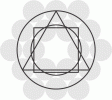
A stone that’s not a stone.
“In the earliest times Greek divinities were worshipped in the form of a heap of stones or a shapeless column of stone or wood. In many parts of Greece there were piles of stones by the sides of roads, especially at their crossings, and on the boundaries of lands. The religious respect paid to such heaps of stones, especially at the meeting of roads, is shown by the custom of each passer-by throwing a stone on to the heap or anointing it with oil. […] Hermae were so called either because the head of Hermes was most common, or from their etymological connection with the Greek word ἕρματα (blocks of stone), which originally had no reference to Hermes at all.” –WP
The myth of Deucalion and Pyrrha features stones as a symbol, but it’s the bible that says the most about Stones:
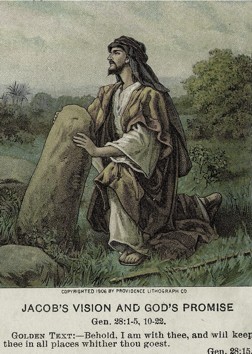
- Jacob has a special moment with a stone. Jacob and God pinky-swear to hang out more.
- Moses hangs out on a giant rock for a while and gets some very important stone tablets with God’s laws written on them. This is the covenant between God and man. Moses gets in on the pinky swear.
- David uses a stone to kill a giant. Later in a Victory song he repeatedly calls God his rock.
- Solomon builds a fancy stone temple.
- Jeremiah tells folks that a new day is coming when the covenant will no longer be written in stone but on the hearts of men.
- Then Jeremiah is right because many years later Jesus Christ is all over this.
- He nicknames one of his buddies Rocky.
- He says good things about a house built upon rock.
- He had a giant stone in front of his tomb.
- The stone is rolled away and Jesus wins.
- All Jesus’ friends keep talking about Him – the living stone – and they say we should be like living stones too.
As you come to him, the living Stone—rejected by humans but chosen by God and precious to him — you also, like living stones, are being built into a spiritual house to be a holy priesthood, offering spiritual sacrifices acceptable to God through Jesus Christ. For in Scripture it says:
“See, I lay a stone in Zion,
a chosen and precious cornerstone,
and the one who trusts in him will never be put to shame.”
Now to you who believe, this stone is precious.
– 1 Rocky 2: 4-7
So… stones are good, living stones are better, and Jesus is the cat’s eye marble in our sack of living stones. What does that make the philosopher’s stone?
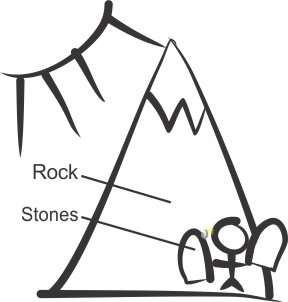
Greek myth and the bible shows us that the symbolism of the stone has something to do with the covenant, between man, and God. To explore the spiritual symbolism further let’s picture some stones and rocks. (In Greek, this is the difference between ‘petros’ and ‘petra’. Scholars have fun debating this because of Catholicism’s primacy of Peter.)
In the old testament: Moses climbs a mountain (a giant rock) and gets stone tablets. From big rocks, stones are cut. The stone and the rock are of the same material but the stones are smaller, shaped, and can be carried away. In the Christian1 imagery, we see this same idea used with living stones – people. We are, like Moses’ tablets, a chip off the old block. God is our Rock. Men are the Stones.
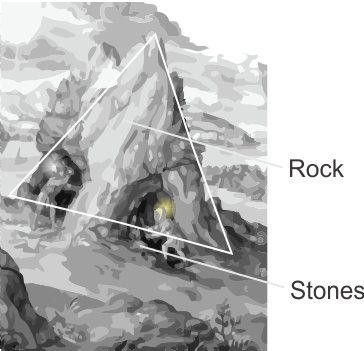
Some miners dressed in white
and yellow dig ores from a mountain.
But it’s inadequate to summarise ‘Stone = Man’. The stone represents man in the image of god. This symbolism stresses that we are from God, near God, like God, and connected to God and all of nature through this. Picture a rocky slope and the rubble that has fallen near it. We’re all mini-gods, “children of God”, and a portion of God. This is the covenant. This is Valentinus Michael Smith’s “Thou Art God”.3
In this way temples, masonry, and Peter take on another level of meaning. Jesus tells us that he is the capstone – A fancy stone, but still a stone. Esoteric types have picked up on this and we can see this symbolism continued, most notably with the Freemasons.
If Peter encourages us to be living stones, the philosophers stone is just that. It’s the wisdom (soph) loving (philo) mini-god (stone). We have been dug from the rock. Veins of metallic ores are in us. We are refined, cut, and built together to become the temple.
1 This is as good a time as any to mention that the words ‘Christ’ and ‘Chrysalis’ have connection to gold.
3 ‘Thou art God’, should be preceded by serious introspection on the nature of god. Stranger in a Strange Land is a good read.
 Naked Alchemy Projections