The term “alchemy” is frequently used in branding, advertising, new age ventures, literature, and art, to describe an impressive transformation. We can find books with titles such as “The Alchemy of Spaghetti,” or software companies that name themselves “Alchemy Inc” after creating an incredible app out of nothing. However, the casual use of the term in these contexts can obscure the complexity and depth of true Hermetic Alchemy.
(In addition to these examples, the term “alchemy” is also used to describe the work of self-help coaches, counsellors, psychiatrists, homeopaths, herbalists, spagyricists, goldsmiths, jewellers, miners, designers, builders, architects, chemists, biologists, physicists, pharmacists, producers, artists, musicians, social and political reformers, genderqueer sex magic evangelists, parents, personal trainers, medical doctors, dietitians, secret society members, spooky kids, and gamers.)
The casual use of the word alchemy in most these contexts pains me (and not just because it makes the real deal harder to google). Alchemy is a specific philosophy. That being said, the things listed above, from sex work to nuclear physics, are all indeed potential practical applications of alchemical theory. They’re also paths someone might take when learning alchemy. But a chemist, counsellor, musician etc. does not an alchemist make. The fitness guru down at the East Side Alchemy Gym might transform your ass into something beautiful, but it’s only alchemical if he’s using alchemy to do it.
Maybe alchemical red herrings and pitfalls are advantageous to us in some way. The process of attempting, evaluating, and failing can teach us valuable lessons. Even the most distinguished medieval alchemists admit that they wasted much of their time on misguided experiments before finally discovering the light. Nevertheless, these same authors spent considerable time exposing the errors of others, presumably to prevent their readers from repeating the same mistakes
So, how do we differentiate alchemy from other types of transformation?
Solve et Coagula:
- Phases from nigredo through to rubedo.
- The subject of the work must be deconstructed, perfected in all its aspects, and then reconstructed.
Ora et Labora:
- Prayer and work are essential components of alchemy.
- Alchemists recognise a higher power.
- Genuine alchemists engage with body, soul, and spirit—no exceptions.
Prerequisite knowledge of nature and the universe:
“The true artist is aided by nature’s bounties, intelligence, perseverance, reading, practical work, books, free will, wealth, and expenses, and is commended for their temperance, piety, integrity, vigilance, and diverse learning.” -Maier
Internal application towards the stone; external application through projection.
There are countless other fundamental concepts integral to alchemy, such as “prima materia” and the four elements. I would hesitate to use the term “alchemy” to describe something that does not incorporate these core ideas.
No More Exoteric Recipes!
The physical world is a third of the equation. Studying nature is advantageous, but this, in isolation, will not make you an alchemist.
Let us clearly state, since so many educated and sincere people seem unaware of the fact, that the real ancestor of our modern chemistry is ancient spagyrics and not the hermetic science itself. There is indeed a profound abyss between spagyrics and alchemy….
These [archemists, spagyracists, and chemists], tormented with a desire to search everywhere and to learn everything, are the true founders of a splendid and perfect science to which they bestowed accurate observations, exact reactions, skillful manipulations, and painfully acquired techniques. Let us humbly salute these pioneers, these precursors, these great workers, and let us never forget what they did for us.
However, we repeat, alchemy has nothing to do with these successive contributions. Hermetic writings alone, misunderstood by profane investigators, were the indirect cause of discoveries which the authors had never anticipated. It is in this manner that Blaise de Vigenere obtained benzoic acid by sublimating benzoin; that Brandt could extract phosphorus by seeking the alkahest in urine; that Basil Valentine, a prestigious Adept who did not despise spagyric experiments, established the entire series of antimonial salts and the colloid of ruby gold (2); that Raymond Lully prepared acetone, and Cassius the purple of gold; that Glauber obtained sodium sulphate and Van Helmont recognized the existence of gases. But, with the exception of Lully and of Basil Valentine, all these researchers, wrongly classified among alchemists, were simple archemists or learneds spagyrists.
-Fulcanelli – The Dwellings of the Philosophers VII
Some valuable authors have explained the principles of alchemy through a series of chemical operations. Historically and presently, as Fulcanelli and others have indicated, the uninitiated have taken these principles too literally and have created a system primarily based on physical operations and substances.
As a result, we have seen modern inventions such as ORMUS, The Book of Aquarius, and the work of NDC. A serious investigation of these authors will reveal that they are sincere but incomplete in their alchemical learning, achievement, and instruction. As a serious alchemist, your time is precious, and you are advised to spend it exploring far more ancient sources.
This fire is supernatural
And can be found in live compost and horsedung,
It is called the Fire of the Wise.
Now mark this well
For it can help you in times of need:
But don’t start looking for it in horsedung
It would be a great pity
If you occupied yourself with such nonsense
You would make a laughing-stock of yourself in the whole land.
-Michelspacher
No More Esoteric Recipes!
When authors recognise alchemy as having a strong internal and symbolic component, sometimes their interpretations still miss the mark. Alchemy is not just a series of steps or a self-help guide. It is a spiritual journey that requires dedication, discipline, and a willingness to explore the unknown.
They try to dumb it down to a series of steps and bring alchemy’s “self-help” aspects to the marketplace. This glosses over the whole “imparted by the grace of God” thing and makes alchemy more accessible and sell-able. While they’re not necessarily wrong, they deviate from the original intention of alchemy.
To draw a parallel from a related topic, The Secret is a not-wrong tidbit of gnostic wisdom. But it’s just that — a tidbit, and now she’s dressed up in polyester and wants you to pay for dinner. The Secret promises quick fixes and easy solutions. True alchemical learning cannot be handed to you. It requires hard work, dedication, and a willingness to explore the unknown. There is a difference between what we know to be true from experience and serious examination, and what we think to be true because someone dictated it. Be prepared to roll up your sleeves and do the hard work.
No New-Age. Old-Age!
Alchemy and Hermeticism is old stuff. Though it accents universal principles that have strong cross cultural connects, be wary of modern new age approaches that fuse all sorts of esoteric wisdom schools together. Crowley’s 777 formed tables of correspondences mapping chunks of wisdom one-to-one. In the last century this trend has continued and an amazing variety of mystical thought has boiled to the surface neatly correlated. Alchemy has been fused with the likes of tarot, witchcraft, shamanism, tantra, numerology, what-have you. Alchemy itself is enough – in both adequacy and challenge.
The Hauck Method (The Emerald Formula)
Dennis Hauck is the president, of the International Alchemy Guild. In this capacity, he founded the Alchemy Journal and International Alchemy Conference which you can also pay some money for. In 1998 he launched the Alchemy Home Study program which can sell you their full program for a little shy of $500. If you want to be a certified alchemist, he can also sell you an $80 certification. Hauck also owns Crucible.org which can sell you alchemical supplies. He also owns Alchemylab.com and has a hand in some related social networking resources on the web. The Hauck method is summarized in the following seven steps:
- Calcination
- Dissolution
- Separation
- Conjunction
- Fermentation
- Distillation
- Coagulation
In his books, most notably, The Emerald Tablet: Alchemy for Personal Transformation and The Idiots Guide to Alchemy, Hauck tells us that the secret of the Alchemical process is given to us in the text of the Emerald Tablet. The Emerald Tablet is a wonderful text that gives us an outline of Hermetic thought. But, the derivation of these seven chemical operations from it is, in my opinion, less than wonderful. It’s reaching… a lot. It’s not all bad, but be aware his alchemical method is the modern invention of one man. Much like the Kyballion’s seven hermetic principles are disseminated-in-error as a cornerstone of Hermetism, Hauck’s seven steps have been referenced by plenty of well-meaning seekers as if they were canon. They are not.
Twelve Step Program
Just like many writers set out the alchemical steps in sevens on account of planetary influences, others corresponded to zodiacal perfection in a series of twelve steps. One of the better known of these is The Twelve Gates of Ripley.
● The First Gate – Calcination
● The Second Gate – Solution
● The Third Gate – Separation
● The Fourth Gate – Conjunction
● The Fifth Gate – Putrefaction
● The Sixth Gate – Congelation
● The Seventh Gate – Cibation
● The Eighth Gate – Sublimation
● The Ninth Gate – Fermentation
● The Tenth Gate – Exaltation
● The Eleventh Gate – Multiplication
● The Twelfth Gate – Projection
This similar example comes from Wikipedia (And perhaps before that, someone’s ass. I dunno. No references were given.)
● Decomposition through Oxidation (Aries)
● Decomposition through Digestion (Leo)
● Decomposition through Fermentation/Putrefaction (Capricorn)
● Modification through Congelation/Coagulation (Taurus)
● Modification through Fixation (Gemini)
● Modification through Ceration (Sagittarius)
● Separation through Distillation (Virgo)
● Separation through Sublimation (Libra)
● Separation through Filtration (Scorpio)
● Union through Solution (Cancer)
● Union through Multiplication (Aquarius)
● Union through Projection (Pisces)
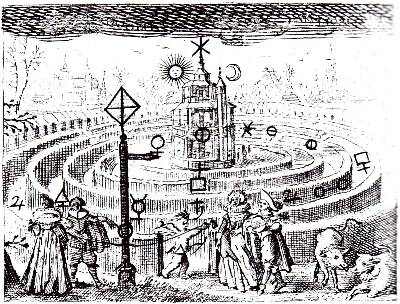
Manly P. Hall gives us the following twelve:
- Aries -Calcination
- Taurus-Congelation
- Gemini-Fixation
- Cancer – Dissolution
- Leo-Digestion
- Virgo – Distillation
- Libra-Sublimation
- Scorpio-Separation
- Sagittarius-Incineration
- Capricorn-Fermentation
- Aquarius-Multiplication
- Pisces-Projection
Not all methods need to adhere to the seven or twelve step rule. Manly P. Hall also pictures Samuel Norton’s 14 step tree: Solution; Filtration; Evaporation; Distillation; Separation; Rectification; Calcination; Commixtion; Purification; Inhibition; Fermentation; Fixation; Multiplication; Projection. At least everyone can agree that multiplication and projection come last! Khalid gives it to us in six steps: Dissolution; Separation; Sublimation; Fixation, or Congelation; Calcination; and Ingression.
Many authors give warnings in their prefaces. “Everyone else is misleading you. Here, I’ll make it simple for you.”, they say. “Read my book several times. Do not alter a word of it or the meaning will be lost!” They then proceed with contradictory recipes masked in ambiguous symbols. Some are deliberately muddied. Others may contain secret meanings or ciphers. Other times, you’re left to wonder which writings are chemical and which are alchemical. Even Paracelsus may be giving you practical pharmaceutical advice sometimes, and deep eternal wisdom other times.
“In our time, the Philosophical Art has become a very subtle matter; it is the craft of the goldsmith compared with that of the humble workman who exercises his calling at the forge. We have made such mighty strides in advance that if the ancient Masters of our science, Hermes and Geber and Raymond Lullius, were to rise from the dead, they would be treated by our modern Alchemists not as Sages but as only humble learners. They would seem very poor scholars in our modern lore of futile distillations, circulations, calcinations and in all the other countless operations wherewith modern research has so famously enriched our Art though without understanding the sense of the ancient writings. In all these respects, our learning is vastly superior to theirs. Only one thing is unfortunately wanting to us which they possessed, namely, the knack they had of actually preparing the Philosopher’s Stone. Perhaps, then, their simple methods were after all the best;…”
– Sendivogius, The New Chemical Light
Conclusion
When it comes to chemical operations there is no standard set of laboratory processes to guide us. The expectation that we should be in receipt of a secret recipe, is another alchemical red herring – A distraction from true pursuit. So where does that leave us?
“Several Hermetick Philosophers have provided a method for the diligent seeker which can be used as a kind of Ariadne’s thread to •nd one’s way through the labyrinth-ine obscurity of alchemical literature: select the best books, read and re-read them, carefully compare the places where they agree and how they agree, for there the truth is to be found. Also compare where they differ and how they differ, for further discoveries will still be made. Be suspicious when they appear to speak most clearly and candidly; and meditate upon the places where they are most obscure. Thus little by little the pattern of truth will emerge, like the watermark in paper held up to the light.
Each and every individual who is seriously interested in alchemy must patiently submit to this ordeal, which is in fact an initiation. There are no short cuts, and over the years I have learnt through bitter experience that nothing in this field can be made ‘easy’ without damage. For the lesson of the Ancient Way can truly be learnt only by travelling upon it. All else is pure speculation, futility and vanity.”
-Stanislas Klossowski de Rola, The Golden Game
Arthur Dee’s Fasciculus Chemicus seems to be one of the sources of de Rola’s advice. Following these same principles, Dee’s book consists of a series of quotations finding a path amongst commonalities and contraries. Amazing!
 Naked Alchemy Projections