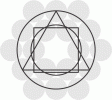
In this Module we’ll learn about the square and the world of matter. The Classic four elements appear frequently in alchemy. These represent the constructs of the material world. This Aristotolean outlook is important if you want to explore the alchemical world through plant experiments for example. For the spiritual alchemist concerned with the prima materia, this module may be of less importance. Basil Valentine explains:
“You need not look for our metallic seed among the elements. It need not be sought so far back. If you can only rectify the Mercury, Sulphur, and Salt (understand, those of the Sages) until the metallic spirit and body are inseparably joined together by means of the metallic soul, you thereby firmly rivet the chain of love, and prepare the palace for the coronation.” – The Twelve Keys of Basil Valentine
Concepts
The square is our playing field. It doesn’t matter how good a player you are, if you never get off the bench. When the universe is broken down into four it is most often a bisection of the concepts presented in duality and represent the visible forces .
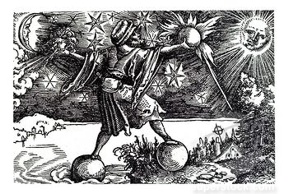
The Four Elements – Our square represents the four elements. These “elements” are sometimes compared to the modern concepts of “states of matter” (Solid, Liquid, Gas, and Plasma). They do not equate to modern atoms except in that they both took their turns being imagined as the smallest component parts of the matter on offer.
Around 450 B.C.E. when Empedocles and others circulated opinions on the basic building blocks of the material world. The idea of the four elements likely date back much further than the Greeks.
Humourism – Not long after Empedocles, Hippocrates threw a medical spin on this. If the material world is made of these four types of matter, so too are we humans. The fluids blood, yellow bile, black bile, and phlegm were assigned to the elements. Sanguine, Melancholic, Choleric and Phlegmatic personalities were later coined by the physicians based on this same idea.
Elemental Qualities – For each corner of the square Aristotle discussed a corresponding side, blending the attributes of its neighbouring corners. These are hot, cold, dry (perhaps properly called “hard”) and wet (perhaps properly called “soft”).
Fifth Element / Quintessence / Aether – Plato in Epinomis gives us the concept of the fifth element. Some schools of thought plot this quintessence as a spiritual fifth element using the pentagram. This is problematic as it portrays aether along side the other elements as its equal – one fifth of the equation. There is a place for the fifth element in our square, but it rightly belongs in the middle, and is more heavily emphasized from
an alchemical standpoint. If you are a fan of pentagrams, you may wish to take a look at some of the concepts presented in the Circle and Triangle sections of this page to get a better idea of how “spirit” is incorporated into the philosophers stone geometric model.
Culture
The four elements (or some variation of them) is an idea common to countless cultures. Where nature was easily divided in half, it was bisected once more into our square.
Modern westerners often see the elements portrayed as the domain of pagans and witches. After all, this is the stuff you’ll find littered through Harry Potter, and Tarot cards. But the four elements, although reflecting nature, are not solely owned by nature religions or natural magic.The four elements are foundational and main-stream. Take a look at the Kink’s Lola vs. The Powerman album cover, or Pink Floyd’s Wish you Were Here. Look at the Windows logo on your computer.
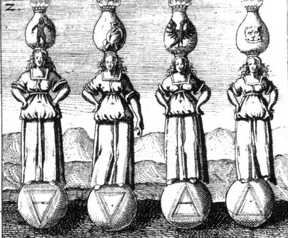
Christianity also enveloped the elements, embracing the cross (instead of a Tau cross or pole) in its imagery and later recognizing the correspondence in symbols like the Rosy Cross. Irenaeus even rubber stamps the canonical gospels based on elemental thinking:
“But it is not possible that the Gospels can be either more or fewer in number than they are. For since there are four zones of the world in which we live, and four principal winds, while the church has been scattered throughout the world, and since the ‘pillar and ground’ of the Church is the Gospel and the spirit of life, it is fitting that she should have four pillars, breathing incorruption on every side, and vivifying human afresh. From this fact, it is evident that the Logos, the fashioner demiourgos of all, he that sits on the cherubim and holds all things together, when he was manifested to humanity, gave us the gospel under four forms but bound together by one spirit. As also David says, when entreating His manifestation, “Thou that sittest between the cherubim, shine forth.” For the cherubim, too, were four-faced, and their faces were images of the dispensation of the Son of God. For, [as the Scripture] says, “The first living creature was like a lion,” symbolizing His effectual working, His leadership, and royal power; the second [living creature] was like a calf, signifying [His] sacrificial and sacerdotal order; but “the third had, as it were, the face as of a man,” — an evident description of His advent as a human being; “the fourth was like a flying eagle,” pointing out the gift of the Spirit hovering with His wings over the Church.
Earth
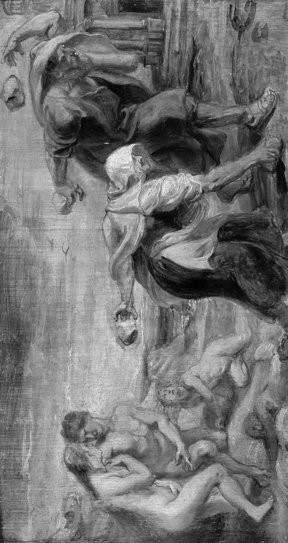
Tell how we may restore, by second birth,
Mankind, and people desolated Earth.
Then thus the gracious Goddess, nodding, said; Depart, and with your vestments veil your head: And stooping lowly down, with losen’d zones, Throw each behind your backs, your mighty mother’s bones. Amaz’d the pair, and mute with wonder stand, ‘Till Pyrrha first refus’d the dire command. Forbid it Heav’n, said she, that I shou’d tear Those holy reliques from the sepulcher. They ponder’d the mysterious words again, For some new sense; and long they sought in vain:At length Deucalion clear’d his cloudy brow,
And said, the dark Aenigma will allow
A meaning, which, if well I understand,
From sacrilege will free the God’s command:
This Earth our mighty mother is, the stones
In her capacious body, are her bones:
These we must cast behind. With hope, and fear,
The woman did the new solution hear:
The man diffides in his own augury,
And doubts the Gods; yet both resolve to try.
Descending from the mount, they first unbind
Their vests, and veil’d, they cast the stones behind:
The stones (a miracle to mortal view, But long tradition makes it pass for true)
Did first the rigour of their kind expel, And suppled into softness, as they fell;
Then swell’d, and swelling, by degrees grew warm; And took the rudiments of human form.
Imperfect shapes: in marble such are seen, When the rude chizzel does the man begin;
While yet the roughness of the stone remains, Without the rising muscles, and the veins.
The sappy parts, and next resembling juice, Were turn’d to moisture, for the body’s use:
Supplying humours, blood, and nourishment; The rest, too solid to receive a bent,
Converts to bones; and what was once a vein, Its former name and Nature did retain.
By help of pow’r divine, in little space, What the man threw, assum’d a manly face;
And what the wife, renew’d the female race.
Hence we derive our nature; born to bear Laborious life; and harden’d into care.
– From Ovid’s Metamorphoses
Water
You’ve got some water right? Go for a swim. Get some going in a double boiler and steam yourself up some veggies. We want to meditate on these things in line with our experiential knowledge.
 The cultural parallels we make with the four element system is not an idea that has been confined to Western philosophy. Ideas that divide our cosmos in half, can be divided in half again. Many cultures have explored this at very basic level naming the four cardinal directions and the four winds.
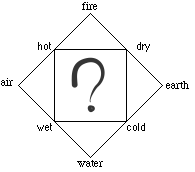
Take a look at the elements and how they mesh with the concepts of active and passive presented in the circle. Convention has us bisecting the elements between the male and female but which are which?
Air
In less ancient days, Carl Jung stood out in his mainstream application of elemental theory. His four functional types (thinking, feeling, sensation, and intuition) are taken directly from ancient ideas surrounding the elements. As such, it’s easy to for us to draw parallels between Jung and other applications with the same root. Examples include Paracelsus and the tarot cards.
For discussions on Jung and his studies related to alchemy and gnosticism, I recommend taking a peek at his written works. Stephan A. Hoeller does a fantastic job outlining these in his essays and online lecture series. Jung, being all about psychology, skewed alchemy toward this end, but his work stands out as both a successful modern application of alchemical theory, and a huge step towards re-merging these religious and spiritual philosophies with socially acceptable science.
Fire
What kinds of fire are there in the world? You got some inside you? You got some outside you? Alchemy challenges us to express the wishy-washy non-physical, in a language that lends itself to the material world. To teach a kid about cars I might point at examples like a Mustang, or a Toyota and say “that’s a car”. To understand the car they’d probably have toss a few examples to know the difference between a car and a truck. Maybe they’d go for a car ride and understand cars even more.
But say I wanted to teach that kid about something non-physical like passion or intuition. What would I point to? Maybe one day we’d see a couple kissing and I would say, “that’s passion”. But would the kid get it? Would they understand passion and how it feels in your eyes and how it lifts you a couple inches off the ground? How it can be directed at jobs, and self, and lovers, and ideas? How sometimes it goes really really well, and
sometimes it blows up in your face? I don’t think so. They’d have to see more examples and experience this abstract thing themselves.
The fire concept seeks to teach us about something we might have trouble putting into words. Lucky for us, the fire analogy is not limited to alchemy. It permeates our culture. I could tell you I’m “fired up” and you would know what I’m talking about. There are no shortage of expressions that might help us reflect upon what the alchemist means when they’re talking about fire and heat.
“She’s got a spark in her eyes”
“Keep the home fires burning”
“She’s holding a torch for him”
“I’m about to explode”
“Wow, that’s hot!”
“She sets my pants on fire.”
“Somebody lit a fire under his ass!”
“Candle in the window.”…
When learning about other aspects of the stone, remember the limitations of language in relation to non-physical. We don’t always have these hints from pop-culture to help us out. Know that you’re not going to understand it just by reading about it. You’re going to need some examples and you’re going to need some experience.
 Naked Alchemy Projections