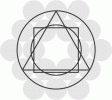
Michael Maier’s 1617 Atalanta Fugiens is a multimedia masterpiece. Modeled around the tale of Atalanta and Hippomenes, Maier sets this work out in a series of 50 chapters. Each chapter consists of a woodcut by deBry, a verse, a discourse, and a musical score. Each showcases an alchemical topic and shouldn’t be mistaken for an orderly alchemical step-by-step process. What follows is a copy of one of Maier’s 50 chapters followed by my short analysis. Even if you don’t care for the analysis, the original work is a pleasant and insightful read that speaks for itself.
Maier’s complete Atalanta Fugiens can be found on Scribd. I’ve also included a modern performance of the fugue for this chapter by Fairy Consort Early Music Ensemble. All 50 of the fugues can be found on youtube, in midi and other formats.
Emblama XLIV
Dolo Typhon Oſyridem trucidat, artuſque illius hinc inde diſſipat, ſed hos collegit Iſis inclyta.Typhon kills Osiris by a ruse, and after that he scatters his limbs far and wide, but the famous Isis collects them.
EPIGRAMMA XLIV
Syria has Adonis, Greece has Dionysus,
Egypt has Osiris, who is nobody else but the Sun of Wisdom;
Isis is the sister, wife and mother of Osiris,
Whose limbs are dissected by Typhon,
but which she joins together.
But the phallus was lost, spread over the waves,
For the Sulphur, which produced Sulphur, is missing.
DISCOURSE XLIV
In the first book of our Hieroglyphics we have fully explained and reduced the Allegory of Osiris to its true Original, which is Chemical. And though we shall not repeat that, yet we shall make a discourse parallel to it, whereby we may retain Osiris within the bounds of Ancient Chemistry, all which has been so often sung of and figured out by the Ancient Poets. For you can never possibly persuade me that Osiris was a God, or a King of Egypt. For to me the contrary to both seems apparent from several circumstances. He is indeed the Sun, but it is the Philosophical one. Now that name being often attributed to him, the Vulgar who read it, and knew of no other Sun but that which gives light to the World, interpreted it in that sense.
The Sun of the Philosophers has its denomination from the sun of the World, because it contains those properties of Nature which descend from the celestial Sun, or are agreeable to it. Therefore Sol is Osiris, Dionysus, Bacchus, Jupiter, Mars, Adonis, Oedipus, Perſeus, Achilles, Triptolemus, Pelops, Hippomanes, Pollux. And Luna is Isis, Juno, Venus the Mother of Oedipus, Danae, Deidaneira, Atalanta, Helena; as also Latona, Semele, Leda, Antiope, Thalia. These are the parts of that compound which before the Operation is called the Stone; and by the Name of every metal, Magnesia.
After operation it is called Orcus, Pyrrhus, Apollo, Aesculapius. The Adjuncts are Typhon, Python, the Boar. The Artists are Hercules, Ulysses, Jason, Perithous. And the labours and dangers which those Artists underwent were innumerable. We may see the Labours of Hercules, the Errors of Ulysses, the Dangers of Jason, the Endeavours of Theseus, the Remorse of Perithous. This is the great volume of Matter and Doctrine, through which in every page, Saturn, Mercury and Vulcan do often occur: The first as Father of all, the Cause without which nothing can be effected; the second as the matter or form; the third as the Efficient. Sol takes Luna his Sister to be his wife, Jupiter takes Juno, as Saturn Rhea, and Osiris does Isis. Dionysus is snatched out of his mother Semele, who was burnt by the thunder of Jupiter, that so he may come to maturity in the thigh of his Father Jupiter. Aesculapius from his Mother Coronis; Dionysus being grown up shows men the Use of Wine, making an Expedition as far as the Indies; Osiris and Triptolemus that of Corn, and how to sow it; and Aesculapius that of Medicine. The Greeks call him Dionysus, the Latins Bacchus, the Egyptians Osiris, and the Syrians Adonis. Oedipus killed his Father and married his Mother. Perseus slew his Grandfather; Typhon his brother Osiris; and the Boar, Adonis; Ceres the Nurse of Triptolemus, his Father Eleusiris. Hippomanes overcame Atalanta by a Golden Apple; Tantalus the father of Pelops, obtained Hippodamia by overcoming her in a race of Chariots. Osiris being cut in pieces, was joined together again by Isis, his mother, sister and wife. The child Pelops was boiled and dressed, his shoulder eaten by Ceres and again returned to life, an Ivory shoulder being added to him. Achilles and Triptolemus were put under coals of fire by Night, and in the Day time nourished by milk; one by Ceres his nurse, the other by his mother Thetis. Achilles and Helena were the Causes of the Trojan War: She as the Impulsive, he as the Efficient cause. Helena was hatched from an Egg, and at the Nuptials of Peleus and Thetis from whom Achilles descended, that apple of Eris [Discord] which was the the first cause of the Rape of Helena, was thrown about. Pollux was assisting to the Argonauts, who are supposed ( if ever they lived at all ) to have lived at least fifty Years before the Trojan War began, and both he and Helena were produced out of one Egg, therefore Helena was an old woman when she was ravished by Paris. Medea when an old woman, and without a tooth in her Head, was married to Achilles in the Elysian Fields ( unless she restored youth to herself, as she did to Aeson the father of Jason, and as Ceres did to Pelops, for which reason he is said to have been twice Young. ) Perseus received a flying Horse from Pallas, and in recompense brought the head of Medusa to Her to whom Mercury gave a Scymiter, and the rest of the gods other Weapons. Ceres gave Triptolemus a Chariot with flying Dragons. When Pallas was born of the Brain of Jupiter, and Sol was in conjunction with Venus, it rained gold at Rhodes. And Jupiter in the form of a golden Shower lay with Danae, as a Swan with Leda; as a Cuckoo with his Siſter Juno; as a Bull with Europa; as a Satyr with Antiope.
And so there is a concord in them all.
Analysis
The primary theme of section forty-four is that of archetype. Though principles related to alchemical death, dissolution, quest, marriage, and rebirth are presented, they appear in this particular discourse only in order to illuminate mythological correspondences to the reader.
There is a slight disconnect between the material presented in the emblem, epigram, and discourse. While the later focuses on drawing correspondences, the former focus more on the Isis/Osiris myth itself. The epigram mentions sulphur, an expansion on which is found no where else in this section. The woodcut curiously arranges seven severed pieces of the king and the three men at the centre of the picture. These don’t align with the Osiris myth and instead integrate a correspondence to the tria prima and septenary.
But perhaps the point Maier is trying to get across is that the gory details of the individual myths are not the most import bit. The (unconventional) names of the figures he notes, and the diarrhea of examples, hammer home that the ‘facts’ of these stories are sketchy but their spirit is consistent. The overlying archetype is what’s key. We should note commonalities. It’s all very Joseph Campbell.
Some take away points:
- Reading myth will help us understand archetypes as they relate to alchemy.
- Reading myth will help us understand alchemical authors who use these mythic figures to illustrate their points.
- These myths are not isolated to one culture.
- Alchemical symbols/archetypes may be known by a variety of names. (Indeed this is why we’re often confused by naming conventions and symbols in alchemical works)
- For alchemical purposes we cannot think of Osiris as a god or king. He is the archetype of the Philosophical Sol.
- The Philosophical Sol or Sun is not the same as the common sun in the sky, but shares many of the same attributes.
- Likewise other archetypes such as Isis – Luna have a similar relationship to the moon.
Suggested Further Reading
- Ovid’s Metamorphoses
- Homer’s Illiad and Odyssey
- Hesiod’s Theogony
- The story of Isis and Osiris
- Maier’s Arcana Arcanissima hoc est, Hieroglyphica AEgyptio-Graeca
- Maier’s Atalanta Fugiens
- H.M.E de Jong’s – Michael Maier’s Atalanta Fugiens
 Naked Alchemy Projections